

Your Next Team Member May Not Be Human. Are You Ready to Manage Them?
Your Next Team Member May Not Be Human. Are You Ready to Manage Them?
Why effective AI leadership requires much more than buying the right technology
Most leaders have spent their careers learning how to manage people. They know how to recruit someone, agree objectives, delegate work, review performance and support professional development.
Now they are being asked to manage something completely different.
Artificial Intelligence can research, write, analyse, recommend, organise and increasingly act. AI agents can complete sequences of work across multiple systems, while employees can build specialist AI assistants without waiting for the technology department to become involved.
Your next team member may not be human. In fact, it may already be working for you.
This is why I believe we may be the last generation of leaders to manage only humans. It is also why AI adoption is no longer simply a technology project. It is a leadership, management and employee-engagement challenge.
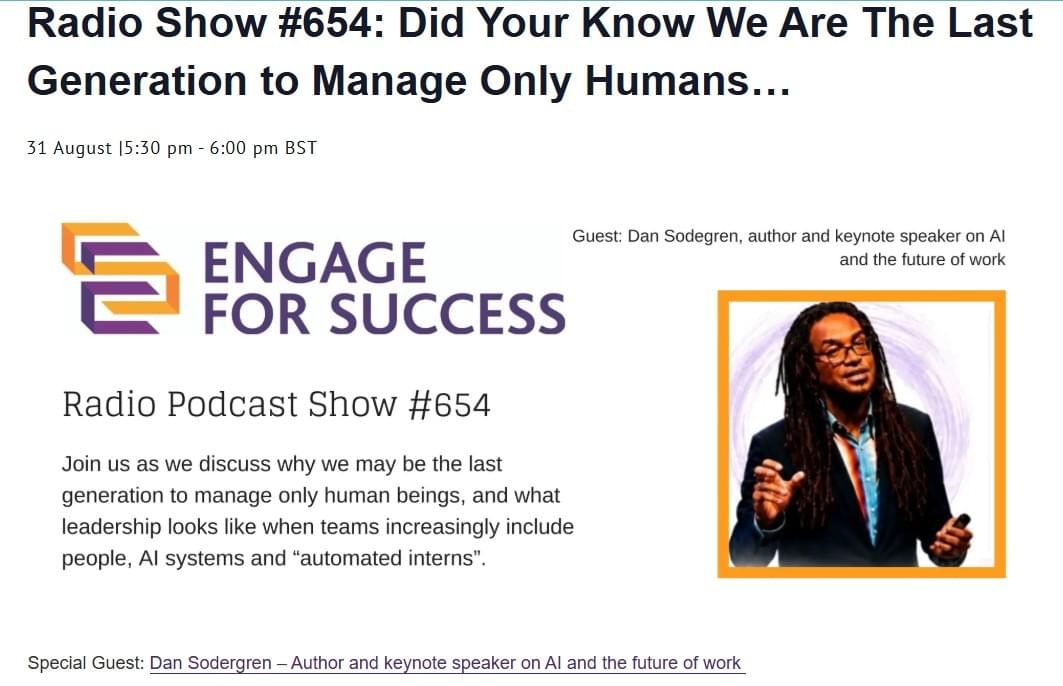
On Monday 31 August at 5:30pm BST, I’ll be joining Jo Dodds on the Engage for Success Radio Podcast to explore what this means for leaders, managers and employees.
Our conversation is called
The title may sound futuristic. The management challenge is already here.
Many leaders assume they need to become AI experts before they can lead an AI-enabled organisation. They worry that they do not understand the tools, terminology or technology well enough to participate in the conversation.
That concern is understandable, but leadership has never required being the most technically knowledgeable person in the room.
A good leader does not need to write every line of code, operate every machine or complete every specialist task. They need to understand what is possible, ask intelligent questions, create the right conditions and ensure that somebody remains accountable for the result.
The same principle applies to Artificial Intelligence.
Leaders need enough knowledge to understand the opportunities and risks. More importantly, they must know how to allocate work between people and AI, establish clear standards and help employees adapt without losing trust.
This is the real work of AI leadership.
Why I Describe AI as an Automated Intern
I call AI an “automated intern” because it gives managers a practical mental model for using it.
An automated intern can be fast, capable and endlessly enthusiastic. It can absorb extraordinary amounts of information and produce useful work in seconds. However, it does not automatically understand your organisation, customers, culture, commercial priorities or definition of quality.
Like an inexperienced intern, it needs a clear brief, appropriate context, supervision and feedback. Its work must be checked before important decisions are made or anything reaches a customer.
The automated-intern model also reminds leaders of something crucial: delegation does not remove accountability.
If a manager gives an employee a poor brief and receives poor work, the manager carries some responsibility. The same is true when delegating work to AI. Blaming the software afterwards does not repair the customer relationship, recover the leaked data or reverse a flawed decision.
AI can complete the task. It cannot carry the ultimate responsibility.
Seven Rules for Managing AI Systems and Agents
Organisations do not need to wait for a perfect enterprise AI strategy before developing better management practices. They can start by applying seven clear rules to every automated intern or AI agent they introduce.
1. Define the Job Before Choosing the AI Tool
Organisations often start with the technology. They buy licences or adopt the latest system and then ask employees to find productive uses for it.
Strong AI leadership begins with the work.
What outcome are you trying to achieve? Which tasks consume unnecessary time? Where are employees repeatedly processing similar information? Where could AI improve speed or quality without introducing unacceptable risk?
Once the work is understood, leaders can decide whether AI is appropriate. Technology should serve a defined purpose rather than become a solution looking for a problem.
2. Give the AI a Proper Brief
A vague instruction usually produces a vague result. This is as true for people as it is for machines.
An effective AI brief should explain the objective, audience, context, constraints and required format. It should identify relevant sources, define what success looks like and state what the system must not do.
For example, “Write a report about our customers” is not an adequate brief. A stronger instruction would explain who will read the report, which customer segment matters, what evidence can be used and which decisions the report needs to support.
Teaching people to brief AI well is not merely prompt engineering. It is clear management communication.
3. Give Every Automated Intern a Human Manager
Every important AI workflow should have a named human owner.
That person should understand what the system does, which information it can access, how its output will be checked and when human intervention is required. If the AI interacts with customers or affects employees, the organisation must also establish a clear route for escalation.
The more autonomous an AI system becomes, the more important this ownership becomes.
AI agents may perform work without constant supervision, but autonomy should never mean absence of accountability. Someone must still be responsible for the agent’s purpose, permissions and performance.
4. Establish Quality Standards
AI can produce work that looks polished while containing factual errors, weak assumptions or invented evidence. This makes clear quality standards essential.
Leaders should define which outputs require verification, which sources are acceptable and what level of accuracy is necessary. High-risk work involving finance, employment, safety, legal decisions or sensitive customer information requires much stronger controls than an internal brainstorming exercise.
Managers should also ensure employees understand that confidence and accuracy are not the same thing. An AI system does not become correct simply because its answer sounds convincing.
5. Improve Performance Through Feedback
The first output from an AI system should rarely be treated as the final answer.
People need to question it, identify weaknesses and provide more context. Over time, effective users learn how to shape their AI systems around the organisation’s language, knowledge and standards.
This process resembles coaching. The manager reviews the work, explains what needs to improve and helps the automated intern produce a better result.
Organisations that encourage this iterative approach will develop more capable people and more useful AI systems. Those that expect perfect answers from the first instruction will either become disappointed or unknowingly accept poor work.
6. Create Psychological Safety Around AI Experimentation
Employees need a safe way to experiment, ask questions and admit mistakes.
If people believe they will be criticised for not understanding AI, they will hide their uncertainty. If they fear punishment for using unapproved tools, they may hide their AI activity as well. Neither response produces responsible adoption.
Personio’s Workforce Pulse research found that only 36% of employees believe their employer provides adequate AI training or support, while 44% want more help.
This is not a lack of employee interest. It is an organisational support gap.
Leaders should create controlled spaces where employees can test tools, discuss failures and share successful applications. They should make the boundaries clear without treating every experiment as a disciplinary risk.
7. Redesign Work Instead of Automating Individual Tasks
The greatest value from AI will not come from completing the same work slightly faster. It will come from reconsidering how the work should be organised.
If AI saves an employee five hours each week, leaders must decide what should happen to that time. Should it be used for more output, better customer relationships, creative thinking, professional development or improved wellbeing?
Without a clear answer, AI adoption can simply lead to increased workloads. People complete existing tasks faster and then receive more tasks, while the promised benefits disappear.
Genuine transformation means redesigning roles, workflows and expectations around what humans and AI can now achieve together.
Managers Create—or Destroy—Trust in AI
The role of managers in successful AI adoption is becoming impossible to ignore.
The Microsoft 2026 Work Trend Index found that when managers actively modelled AI use, employees reported a 30-point increase in trust in agentic AI.
When managers created psychological safety around experimentation, employees reported up to 20 points higher AI readiness and value. They were also 1.4 times more likely to be frequent users of agentic AI.
This tells us that AI transformation cannot simply be announced by senior leadership and delegated to the technology department. Managers must demonstrate what responsible use looks like in everyday work.
They need time to learn, freedom to experiment and permission to admit uncertainty. Asking an exhausted and undertrained manager to lead an AI transformation without this support is not a strategy. It is wishful thinking.
AI and Employee Engagement Cannot Be Separated
Employees will judge an organisation’s AI strategy partly through what leaders say, but mainly through what the organisation does.
If leaders promise that AI will support employees while using it primarily to monitor them, trust will decline. If they celebrate productivity but refuse to discuss how the benefits will be shared, employees may conclude that greater efficiency will simply make their jobs less secure.
This is why my Four Intelligences framework combines Artificial Intelligence with Emotional, Independent and Organisational Intelligence.
Leaders need Artificial Intelligence to understand the technology, Emotional Intelligence to lead people through uncertainty, Independent Intelligence to question weak assumptions and Organisational Intelligence to turn experiments into sustainable change.
The technology cannot be separated from the people expected to use it.
The Leadership Choice: Reduce—or Retrain, Retain and Scale?
AI will create genuine opportunities to increase productivity. Leaders must decide what they will do with those gains.
Some will primarily use AI to reduce headcount. Others will retrain employees, retain their experience and use AI to increase what those people can achieve.
The Microsoft 2025 Work Trend Index found that 33% of leaders were considering headcount reductions. However, 78% were also considering recruiting for new AI-related roles, while 83% believed AI would allow employees to undertake more complex and strategic work earlier in their careers.
The future has not been decided by the technology. It will be decided by how leaders choose to use it.
My preference is clear: retrain, retain and scale.
Train people to manage AI properly. Retain the relationships, experience and organisational knowledge they already possess. Then use AI to help those people produce more valuable work.
Roles will change, and some difficult decisions will still be required. However, organisations that redesign work with employees will build more trust than those that quietly redesign employees out of it.
The Leaders Who Will Succeed
Successful AI leaders will not necessarily be the people who know the most technical terminology or can demonstrate the greatest number of tools.
They will be the leaders who can make good decisions about people, work and technology. They will set clear expectations, build trust, encourage intelligent experimentation and ensure human accountability remains visible.
Most importantly, they will understand that managing AI does not reduce the need for human leadership. It increases it.
As systems become more capable, organisations will need stronger judgement, clearer communication and more emotionally intelligent managers. The automated intern may complete more of the work, but human leaders must still decide what work is worth doing and why it matters.
Listen Live: The Last Generation to Manage Only Humans
Join Jo Dodds and me on the Engage for Success Radio Podcast as we discuss leadership, employee engagement and what happens when teams contain humans, AI systems and automated interns.
Monday 31 August 2026
5:30pm BST
You can also read the main article, We Are the Last Generation to Manage Only Humans, and learn more about Dan Sodergren’s work as an AI and future-of-work keynote speaker.

About Dan Sodergren
Dan Sodergren is an AI transformation strategist, author, technology expert and keynote speaker specialising in Artificial Intelligence, leadership and the future of work.
Through his talks, training and AI Leadership Course, Dan helps leaders understand how to introduce AI responsibly, develop their people and build organisations capable of succeeding during the Fifth Industrial Revolution.
Explore Dan’s work as an AI keynote speaker or learn more about his AI leadership training.