

Most leaders are asking the wrong question about AI.
They are asking:
“What tools should we buy?”
“How do we train people?”
“How do we stop employees misusing AI?”
“How do we increase productivity?”
Those questions matter.
Don't get me wrong, with as Dan Sodergren, I train people and organisations in how to use AI to become more productive. But the the real question comes after this...
The real question is this:
"What happens when AI gives your most engaged people superpowers, while the rest of your organisation has already emotionally left the building?"
That is the danger.
Not AI replacing people.
AI revealing the truth about people.
The UNCOMFORTABLE TRUTH...
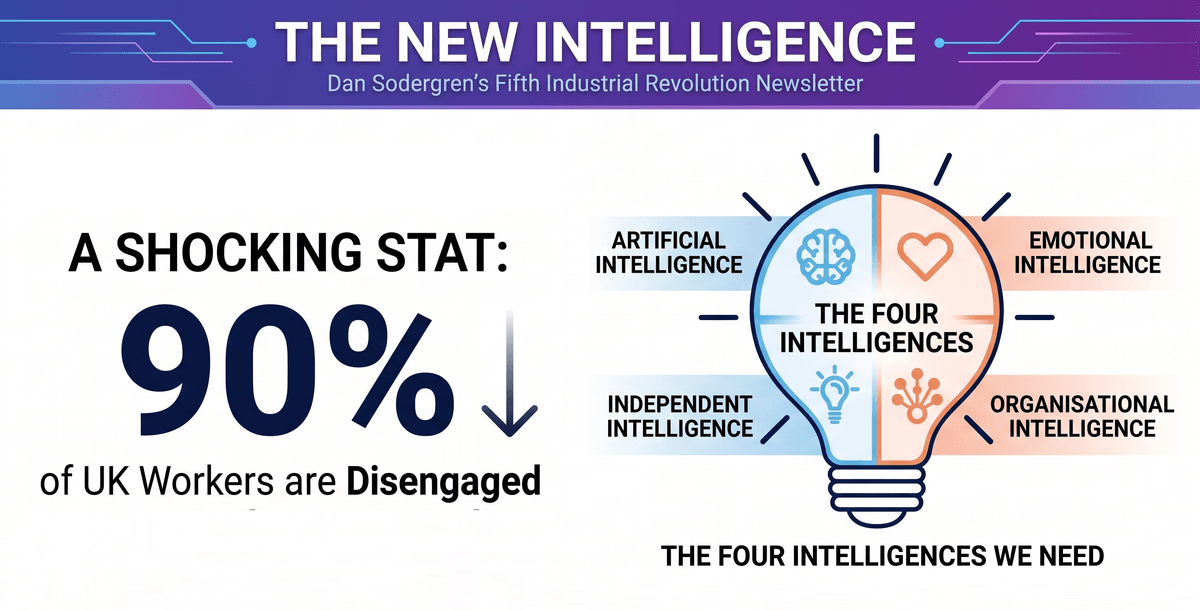
According to Gallup, only 10% of UK workers are engaged at work. Ten percent. That means nine out of ten people are not fully connected to the organisation, the mission, the work, or the leadership.
They may still attend meetings. They may still answer emails. They may still look busy.
But emotionally, many have already checked out.
For leaders, this should be a strategic alarm bell.
Because AI does not treat all employees equally. It amplifies the people who are curious, motivated and willing to learn. It makes the engaged more productive, more independent and more valuable.
The best people will use AI to move faster, think bigger and create more.
The disengaged will use it badly, avoid it, fear it, hide it, or use it just enough to survive.
That creates a dangerous split inside your organisation.
A small group becomes faster, smarter and more powerful.
The majority becomes more exposed.
This is the uncomfortable leadership truth.
AI will not destroy your culture. It will reveal it.
If your people do not trust you, they will hide how they use AI.
If your managers are burnt out, they will not lead adoption well.
If your employees feel disposable, they will not experiment openly.
If your organisation has low psychological safety, AI will become another thing people fear, fake or resist.
That is why shadow AI is not just a technology risk.
It is a leadership warning.
People do not hide tools from leaders they trust. They hide tools when they think honesty may be punished, misunderstood or used against them.
Many organisations are responding with policies, platforms and permissions.
But the deeper issue is not technical.
It is cultural.
And culture is a leadership responsibility.
This is where the danger becomes even sharper.
Gallup also found that 70% of team engagement is attributable to the manager. Yet many managers are themselves exhausted, undertrained and disengaged.
So we now have leaders asking burnt out managers to guide anxious employees through the biggest workplace shift in a generation, using tools many of those managers do not properly understand.
That is not a transformation strategy.
That is wishful thinking.
You cannot delegate the future of work to people who have not been given the time, trust or training to lead it.
This is why as Dan Sodergren, Future of Work Speaker, keynote speaker, technology expert and AI expert, I argue that human psychology is more important than AI technology.
Because AI adoption is not really about software. It is about belief.
Do people believe the organisation has a future?
Do they believe they have a place in it?
Do they believe leaders are being honest?
Do they believe AI is there to help them grow, or quietly measure them for replacement?
Leaders who ignore these questions will make expensive mistakes.
They will buy tools no one uses properly. For example, CoPilot.
They will launch AI strategies no one trusts.
They will talk about innovation
While their best people quietly build exit plans.
They will mistake compliance for commitment.
That is the real danger.
The Fifth Industrial Revolution is not just a technology revolution. It is a people revolution.
And that means leaders need to build four kinds of intelligence across the organisation.
Artificial Intelligence gives people speed and scale.
Emotional Intelligence gives leaders the ability to build trust, reduce fear and have difficult conversations well.
Independent Intelligence gives people the courage to think critically, question outputs and make better decisions.
Organisational Intelligence helps businesses turn ideas into action inside real systems, with real people and real pressure.
This is the core message that sits behind The Fifth Industrial Revolution Keynote.
The companies that win will not simply be the ones with the best AI tools.
They will be the ones with the best leadership operating system.
That means leaders must stop treating AI as an IT rollout.
It is not. It is a test of trust.
A test of culture.
A test of management.
A test of whether people still believe their work matters.
So the leadership challenge is simple.
Do not just buy AI.
Build belief.
Give managers time to learn before expecting them to lead.
Create safe spaces for experimentation.
Reward openness instead of punishing uncertainty.
Talk honestly about productivity, jobs and change.
And most importantly, give people a reason to care.
Because if only 10% of your workforce is engaged, AI will not save you.
It will simply make the gap impossible to ignore.
The future of work will belong to organisations where people want to show up, learn fast and use technology with purpose.
That is the leadership opportunity.
That is the leadership danger.
And that is why this moment matters.
Dan Sodergren is an AI thought leader, Tech Futurist Speaker, Future of Work Speaker and Fifth Industrial Revolution corporate speaker. For organisations looking for a future of work expert for hire, Dan helps leaders understand AI, people, culture and the future of work.